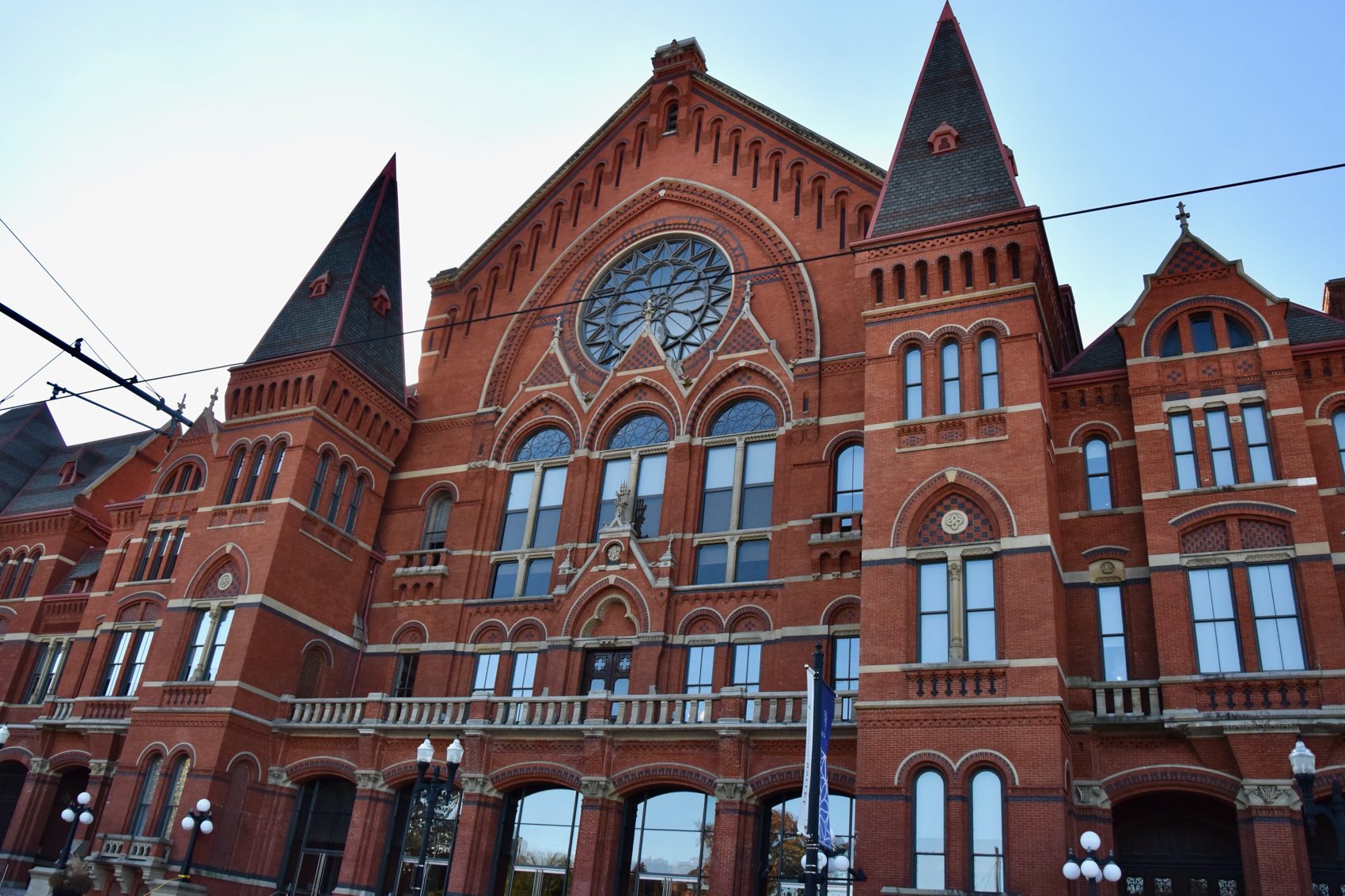
Like an online influencer, some buildings demand attention. Cincinnati Music Hall has been blowing up eyeballs since 1878.
The towering red brick, Gothic arches that would make a vampire swoon, more towers than Mordor, and so much architectural ornament you would think the architect got paid per ornament. From Washington Park, the façade has the kind of heft that makes you marvel in joy while your dog poops.
But a glimpse of the front of Music Hall is only the opening act. The exterior looks like it was built to withstand attacking hordes, but the interior is ready for a Marie Antoinette soirée.
A city gets sick of being second class
Cincinnati Music Hall opened in 1878, with Samuel Hannaford as its architect. If you don’t know who he is, look around Cincinnati. He dreamed this city into being. Music Hall was built for a city that loved music, public assembly, and civic identity as much as it loved brewing beer and killing pigs. Its main concert hall is bookended by spaces intended for exhibitions and other public uses. Like the world’s most impressive rec center, this place was there for you.
To have such a towering shrine to the arts, someone has to spring for it. Enter Reuben Springer, stage left. A bunch of Germans (a bunch of Germans is referred to as a gobblestein) had constructed a large hall in which to drink beer and sing songs, ya know, like Germans do. Their Saengerfest Halle was a hit, especially during the May Festival, a massive choral music festival. When a rainstorm hammered its metal roof in 1875 and made such a racket you couldn’t hear the man next to you say wunderbar, our man Springer sprung into action and helped fund the construction of Music Hall.
If you are lucky enough to stand in front of it, stop for a second. Put your phone away at least long enough to drink in all the little flourishes and bits of brick bling. Good. Now go back to cooking videos on TikTok. Me? I knew I couldn’t convey what I was seeing through the camera lens. Like the moon or a unicorn, some things are just too magnificent to capture.
The building is like a piñata with the good stuff inside (no sticks required)
I’m not a crystal-wearing, energy-field kind of guy, but when I’m in the Basilica in Covington, I can feel all the reverence in the walls. And when I’m inside Music Hall, I feel the murmur of people gathering for a show, the backstage prep and jitters. It’s there, it’s in the air, it’s a feeling.
Springer Auditorium is where the magic happens. And Music Hall as a whole has hosted quite a lineup: Frank Sinatra, Louis Armstrong, Ella Fitzgerald, Miles Davis, and Duke Ellington. Unfortunately not all at the same time, but that would be a pretty decent lineup for a night’s entertainment. Some played the ballroom rather than the auditorium, but the building has been collecting stars for generations. And the history isn’t all opera and orchestra. Trick riders, acrobats, and other variety performers have taken their turns here, too.
Time for you to look up. No need to remind you; you inevitably will, but crane away and drink it in. Grandiose words can’t do justice to the grandeur of the ceiling and its chandelier. Cue the Phantom, here comes the lighting fixture. During the 2016–2017 renovation, the chandelier and surrounding decorative elements received some much-deserved attention.
Through the looking glass
A backstage view is what I love most. For me, this is my happy place in a theater. Don’t get me wrong. I love seeing shows. But when I’m backstage, I feel at home. It’s my safe place and my creative space. Music Hall is a big, beautiful space in front of house and in back. Curtains, cables, technical equipment, and show stuff. Again, you can feel the decades and decades of prep and performance.
When I performed at the New Victory Theater in Times Square, my show partners and I would jump up and down and have ridiculous rituals to help get the blood pumping before stepping into the light. I can only imagine how many thousands of people have gotten psyched up in these beautiful wings.
A place that kept changing
Music Hall has continued to grow and change along with the times. It’s as vital now as it was when horse-drawn carriages rolled the hoity-toity in amongst the hoi polloi. Its 2016–2017 renovation cost about $143 million and took 16 months. 3CDC served as developer and Messer Construction as construction manager, overseeing updates to the stage, acoustics, seating, and public spaces while preserving its historic character. All this helped bring an endangered historic landmark back into fighting shape.
Like a great city, Music Hall rewards going slow and noticing details.
Back out into Cincinnati
Outside, Music Hall faces Washington Park and the streets of Over-the-Rhine. OTR has seen its ups and downs, but its character and impact are going strong in 2026. Beautiful old brick homes, creative offices, and thriving commerce now surround Music Hall, living cheek to jowl with a gritty downtown. It’s a hub for a city on the rise, with a swirling whirligig of festivals and food and fun.
Music Hall is not Miss Havisham in her faded gown. This is alive. It is grand. It is inviting you in. Come enjoy the crown jewel in the Queen City.